
Why Dubai Businesses Need Local SEO in 2026
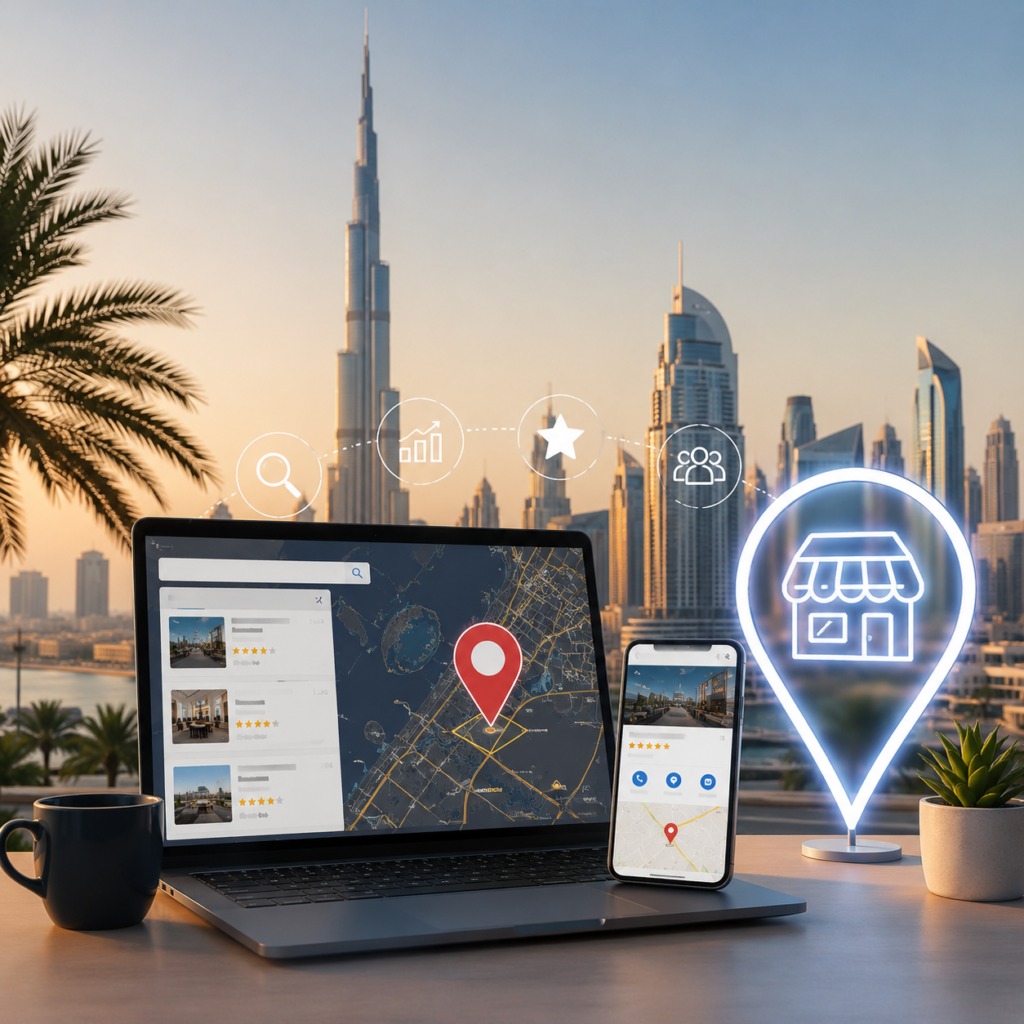
Local SEO in Dubai is the work of making your business easy to find for people searching in your area, easy for search engines to understand, and trustworthy enough that someone gets in touch. Unlike general SEO, which tries to rank a page for a topic, it targets searches with a place attached, like “physiotherapist in Dubai Marina” or “perfume shop near me.”
Here’s why that matters. When someone in Dubai needs a dentist, a salon, a perfume shop or an AC repair company, they usually search on their phone and choose from the first few businesses they see in Google. If your business isn’t there, someone else is likely to get the call.
How local search results work
Google shows local results in three places: the map pack (a short list of businesses on a map near the top), Google Maps itself, and regular website results below.
Google says local rankings depend mainly on three things:
- Relevance: how well your business matches the search
- Distance: how close you are to the searcher or the place named
- Prominence: how well-known and trusted you appear, based on reviews, links and information found about you online
You can’t change where a customer is standing, so most of the work goes into relevance and prominence.
What managing branch listings taught me
Before going freelance, I worked for a perfume company with branches across the UAE, and local search was part of my job. For each branch I created and managed a separate Google Business Profile. I filled in the business name, categories, services, branch details, website link, opening hours, phone number and recent photos, and kept everything matching the company’s website. I replied to customer reviews, and I used the posts feature to announce new perfume launches with links to the product pages.
When people searched for things like “best perfume near me,” the branches appeared for the areas where they were located. A few things stood out from doing this across many locations:
- Each branch needs its own complete profile. A profile that only has a name and a phone number gives Google and customers very little.
- Consistency matters more with several locations. One wrong phone number or opening time is easy to miss when you’re managing many listings.
- Posts keep a profile active, and they give customers a direct route to what’s new.
These are lessons from the work I did. Every business is different, but the basics apply whether you have one location or twenty.
Google Business Profile
Your Google Business Profile is the listing that appears in Maps and the map pack, and for many searches it’s the first thing a customer sees. Get these right:
- The correct primary category, which is the strongest signal of what your business is
- Secondary categories, only if they’re true
- Services, opening hours (including holidays), phone number and website
- A short description written for customers, not a list of keywords
- Real, recent photos
Customer questions are now answered by Google’s AI from what it finds on your profile, website and reviews, so keeping all three accurate matters more than it used to. Review your profile regularly, because old hours and services mislead people.
Reviews
Reviews affect how prominent you look to Google, and they often decide whether someone contacts you or the next business on the list. A steady flow of recent, genuine reviews says more than a burst in one week.
Ask happy customers soon after the service, share a direct review link, and reply to every review, including negative ones, calmly and specifically. Don’t buy reviews or offer gifts in exchange for them. That breaks Google’s policies and can get reviews removed or your profile restricted.
Consistent business details
Search engines try to understand a business as an entity: a name, category, location and contact details connected to other things online. When Google finds the same details in several trustworthy places, it’s more confident about showing you. When they conflict, it isn’t.
That’s why NAP consistency (name, address and phone number) matters. Any mention of those details on another site, such as a directory, is called a citation. Make sure they match across your website, Google profile, directories and social pages. If an old directory still lists a previous phone number, Google has two versions of your business to choose from. Fix or remove old listings, and pick a few relevant directories rather than hundreds of random ones.
Local keywords and your website
People search in different ways: with a city (“SEO consultant Dubai”), a neighbourhood (“salon JLT”), “near me,” or with no location at all. Some also search in Arabic. Find out how your customers describe what they need, and use the areas you genuinely serve naturally. Adding “Dubai” to every sentence doesn’t help.
Many customers click through to your website before deciding. A good service page explains what you offer, who it’s for, where you provide it and how to get in touch. Area pages can help, but only where you really serve the area and have something specific to say. Dozens of near-identical pages with only the neighbourhood changed add nothing.
Two technical extras support all this: LocalBusiness structured data, which describes your name, address, hours and profiles directly to search engines, and mentions from relevant local websites such as business associations and industry directories. Neither ranks you on its own, but both build trust.
Mobile experience
Most local searches happen on phones. When I first tested my own website in PageSpeed Insights, the mobile result was much slower than desktop: first content appeared in 3.2 seconds on mobile against 0.8 seconds on desktop. The page looked fine on a laptop, which is why I always check mobile first.
Open your site on your phone and check how fast it loads, whether a phone or WhatsApp button is easy to find, and whether it’s clear what the business does within a few seconds.
If you travel to customers
If you’re a plumber, photographer or cleaner who goes to customers, set a service area on your Google profile and hide your address if customers don’t visit it. Be honest about the areas you cover. Listing places you don’t serve goes against Google’s guidelines.
Check your own setup in 10 minutes
- Search your business name and main service on your phone and note what appears.
- In Search Console, open Performance and filter queries by your area names.
- Check your profile’s performance for calls, direction requests and website clicks.
- Run your homepage through PageSpeed Insights on the mobile tab.
- Test your structured data with Google’s Rich Results Test.
Local search and AI answers
People now ask AI tools questions like “who’s a good SEO consultant in Dubai?” These tools choose businesses differently from traditional rankings, but they still depend on trustworthy information: consistent details, genuine reviews and clear website content. Getting the basics right supports both. I have already covered this in my post on how AI is changing search in Dubai.
Where should a Dubai business start?
- Fix mismatched business details first, since everything else builds on Google trusting them
- Complete your Google Business Profile
- Ask recent happy customers for reviews
- Check your website on mobile
- Build a focused page for each main service and area you serve
- Track calls, clicks and enquiries, not only rankings
How long does it take?
It depends on your starting point, your industry and how consistently the work is done. Profile and listing fixes can show an effect within weeks, while stronger visibility usually takes a few months. I don’t promise specific rankings or dates, because nobody can honestly do that.
Final thoughts
Local search comes down to making your business easy to find, easy to understand and easy to trust. Start with your business details, Google profile, reviews and website, then build from there.
If you’d like help with local visibility in Dubai or across the UAE, see my local SEO services, read the FAQ page, or contact me.